By Ben Goldsmith for Math 109
Introduction
Countless papers have been written describing and proving the symmetry groups of the Platonic Solids. One common feature of these papers, however, is that almost none of them succeed in giving you an intuition as to what the various symmetries represent.
This is a common problem of mathematical writing: it focuses on the symbols, not on the way people think. Much of the time, mathematics happens as a spatial model in the mind. The symbols should only serve to build that model as quickly as possible!
Once understood, the Platonic Solids are a delight to play with mentally -- but building that intuition from the written word can be frustrating. However, we're no longer bound to the printed word. We now have the technology to go one step further. We can now show you exactly what your mental model can feel like!
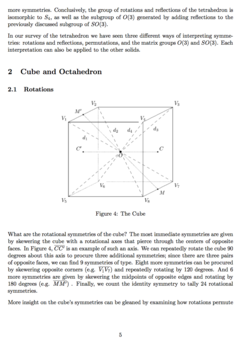
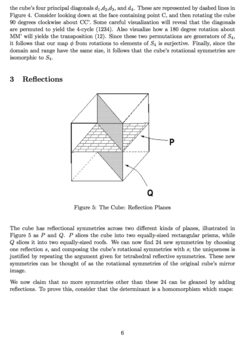
Meet the Solids
Tetrahedron
Cube
Octahedron
Icosahedron
Dodecahedron
So, what are these solids, anyway? The Platonic Solids are the convex solids whose faces are all the same, regular polygon. For example, the Tetrahedron above has faces made of equilateral triangles. The Dodecahedron up there has faces made of regular pentagons. It should be readily apparent how the rest are made. Interestingly, the five solids above are the only solids that exist that meet this criteria!
So, What Is a Symmetry Group of a Solid?
A symmetry group is the set of ways we can transform one of our solids so that it lands back on itself. In other words, after the transformation, our solid is in the exact same spot as before, just with some of its vertices and edges swapped around. If this is confusing, just hold on. It'll make sense real soon!
The Problem
So we've got these cool solids that have a lot of beautiful symmetries. However, these symmetries have a structure, and by the end of this paper, we should have a solid understanding of this structure. In fact, we'll even be able to set up some nice isomorphisms between these symmetry groups and some groups we've seen before! Just as a teaser, here they are:
| Solid | Order of Symmetry Group | Isomorphic Group |
|---|---|---|
| Tetrahedron | 24 | S4 |
| Cube Octahedron |
48 | S4 × C2 |
| Icosahedron Dodecahedron |
120 | A5 × C2 |
In case you've forgotten, the group C2 is the cyclic group {0, 1}, S4 is the Symmetric Group on 4 symbols, and A5 is the Alternating Group on 5 symbols.
Taking the Tetrahedron To Task
Rotational Symmetries
We'll start by examining the rotational symmetries around one axis. This axis goes through the top point and the middle of the bottom triangle. We'll call a rotation around this axis r. Play around with it on the left. Note that there are 3 distinct orientations here:
e = The Blue vertex is on top, Red vertex is in front.
r = The Blue vertex is on top, Green vertex is in front.
r2= The Blue vertex is on top, Yellow vertex is in front.
r3= e
We're at three symmetries now:
Click the tetrahedron to spin about the y-axis.
Click the tetrahedron to tumble about our diagonal axis.
Everyday I'm Tumblin'
This is a good start, but we're clearly never going to get the Blue vertex in front -- we're pivoting around it! To solve this, let's spin it around another symmetric axis. Here, we'll use an axis that bisects two of the edges. We'll call this rotation t. Notice how we have to tumble around a greater angle to get a symmetry here. Spin this a few times to get a sense of where the axis is, and what this rotation does. Go ahead, I'll wait.
e = Blue vertex is on top, Red vertex is in front.
t = Green vertex is on top, Yellow vertex is in front.
t2= e
So, hopefully you've noticed that it swaps the vertices on opposite sides of the axis. We've unlocked one more symmetry! So far, we've found the symmetries:
Green on Top?
Well, four symmetries isn't bad, but we can do better than that. The neat thing about this tumble t is that we can use it to get the green on top of the Tetrahedron! And, once again, we can spin it with r in order to get 2 more symmetries.
t = Green vertex is on top, Yellow vertex is in front.
tr = Green vertex is on top, Blue vertex is in front.
tr2= Green vertex is on top, Red vertex is in front.
We're at six symmetries now:
Click the tetrahedron to spin about the y-axis.
Combination Platter!
You've probably guessed by now, but it's time to combine these in some fun ways. The tumble swaps the bottom-right vertex with the top vertex. Our spin also lets us put any of the bottom vertices into the bottom-right slot. Given this info, try to get all four vertices in the top position.
Spin (r)
Tumble (t)
That was probably pretty easy -- you just moved the vertex you wanted into the bottom-right slot, and then tumbled it up. We've earned a few more symmetries!
rt = Yellow vertex is on top, Red vertex is in front.
r2t= Red vertex is on top, Green vertex is in front.
And of course, once we have a vertex on top, it's got its three spin symmetries:
(rt)r = Yellow vertex is on top, Blue vertex is in front.
(rt)r2 = Yellow vertex is on top, Green vertex is in front.
(r2t)r = Red vertex is on top, Blue vertex is in front.
(r2t)r2 = Red vertex is on top, Yellow vertex is in front.
Note that from experimenting, we find that trt = r2tr2 and that tr2t = rtr. This allows us to simplify arbitrary chains of tumbles and rotations. For example:
rtr2trtr2rt = rtr2trtet = (rtr)(rtr) = (tr2t)(tr2t) = trt = r2tr2
So, we've collected quite the set of symmetries:
{e, r, r2, t, tr, tr2, rt, (rt)r, (rt)r2, r2t, (r2t)r, (r2t)r2}
In fact, we're up to twelve now! This is all we can get with just rotations, it turns out. Any symmetry has to have one vertex on top and one vertex in front, and this uniquely determines the symmetry. The other two vertices only have one possible position: it's the choice of vertices that preserves the right-handedness (or orientation) of the Tetrahedron. That is to say, if Blue is on top and Red is in front, Yellow must be to the left, and Green must be to the right. If they were reversed, then the Tetrahedron would be of the opposite orientation. Since all rotations preserve orientation, this is impossible!
Given this understanding above, we now know that the entire symmetry is determined by picking one of four colors to be on the top, and then one of the remaining three to be in the front. This means there can only be twelve symmetries, and we've found all of them!
Click to reflect through the gray axis
Mirror, Mirror...
The previous discussion raises the obvious question -- what happens if we do allow for reflections? If we set up the simple reflection along the X axis (this is equivalent to reflecting through the YZ plane), we note that the back two vertices simply swap place! We'll call this action s. This is a symmetry we haven't seen before. As noted above, we can't create it simply from rotations! Similarly, if we now spin the Tetrahedron, we can create two more symmetries with Blue on top that require reflection:s = Blue on top, Green on left, Yellow on right.
sr = Blue on top, Red on left, Green on right.
sr2= Blue on top, Yellow on left, Red on right.
s2= e
This clearly generalizes when we add in tumbling: multiplying s by all of the previous symmetries gives us the new set:
{s, sr, sr2, st, str, str2, srt, srtr, srtr2, sr2t, sr2tr, sr2tr2}
Let's Play!
Just like we found some nice properties of the multiplication in the rotational symmetries, let's find similar ones for s, r, and t. Try to find some nice equivalences for rs, r2s, and ts.
Did you try it? You should have found that:
rs = sr2
r2s = sr
ts = srtr2
This last statement implies that tsr=srt, a handy equivalence. Our final set of symmetries of the tetrahedron is:
Isomorphisms
So, our final symmetry group for the Tetrahedron is:{e, r, r2, t, tr, tr2, rt, rtr, rtr2, r2t, r2tr, r2tr2, s, sr, sr2, st, str, str2, srt, srtr, srtr2, sr2t, sr2tr, sr2tr2}
This set has 24 elements. It turns out this has to be the full set! Any symmetry permutes the vertices of the Tetrahedron. Since there are 4 vertices, that means there can be at most 24 different permutations of these 4 vertices. So, every possible permutation of the vertices is in our Symmetry Group.
We're now ready for the coup-de-grace: constructing an isomorphism between our Tetrahedron and S4, the group of permutations. Note that while normally S4 is written using integers to represent distinct elements, it is equivalent to using any other set of distinct elements to be permuted. In our case, the 4 distinct elements are the vertex colors.
Our entire group can be generated by the three operations r, t, and s. These symmetries permute the vertices of the Tetrahedron in specific ways:
r = (Red, Yellow, Green)
t = (Blue, Green)
s = (Green, Yellow)
These permutations use the standard notation of cyclic permutations. It should be pretty clear that the actions of r, t, and s multiply in the same way as the normal Symmetric Group. That is to say, multiplication of r, t, and s is exactly equivalent to the corresponding composition of their cyclic permutations. This is because the symmetry-preserving actions simply permute the vertices. Likewise, a specification of vertices specifies a unique orientation.
Setting up a bijection between the two groups is quite easy: given an element in our Symmetry Group, the corresponding element in S4 is the permutation of the vertex colors on our symmetric group. We know this is unique, since each permutation uniquely specifies an orientation. A simple technique to do this is to substitute in the cycles listed above for r, t, and s. Since both groups have the same size and we've set up an injection from the Tetrahedral Symmetry Group to S4, it must be invertible as well. In other words, it's a bijection.
Since we've set up both a bijection between the two groups, and shown that multiplication in one is equivalent to multiplication in the other, we know there is an isomorphism between S4 and the Tetrahedral Symmetry Group!
Coming Soon: CUBE, OCTAHEDRON, ICOSAHEDRON, AND MORE!
Where MORE = DODECAHEDRON.
Click us! Make us spin!